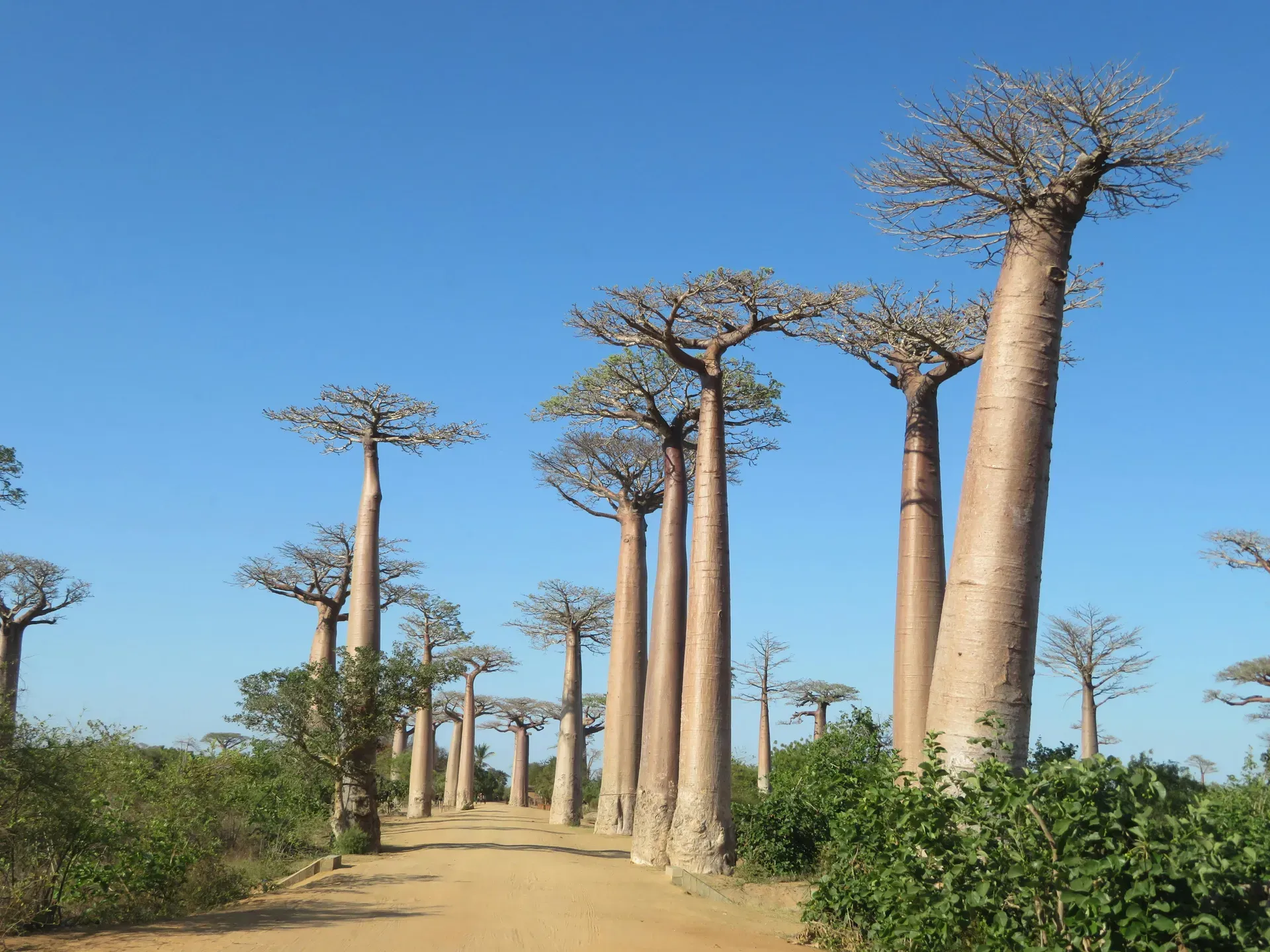
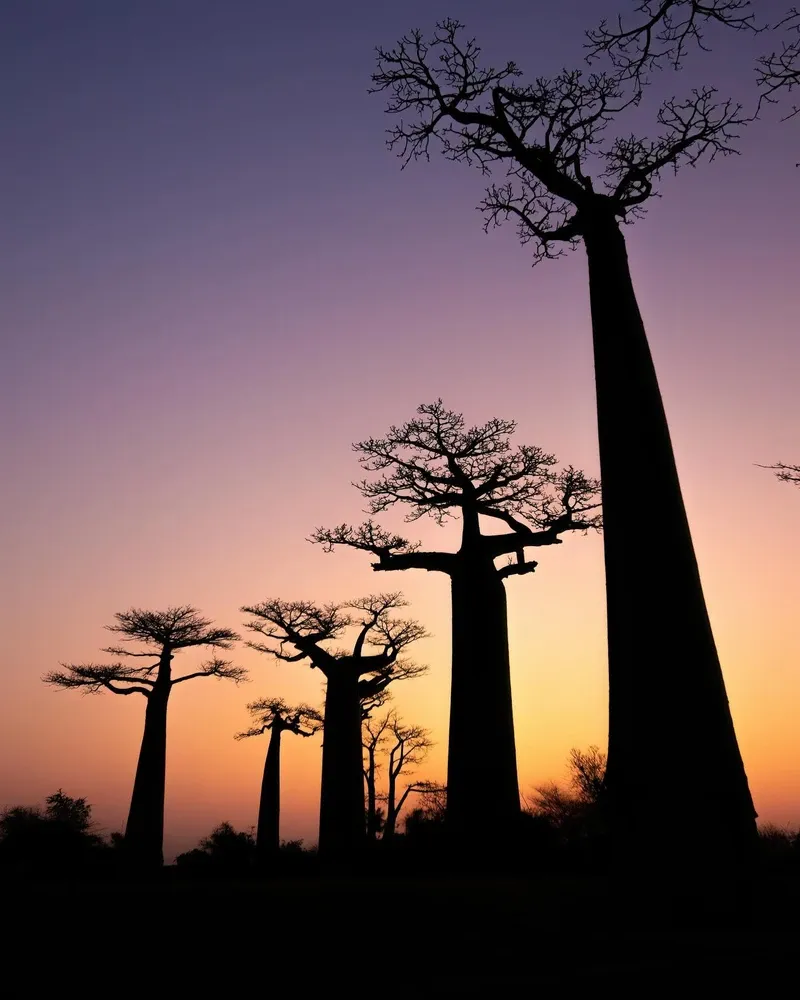
Twenty-five Grandidier's baobabs tower 30 meters above a dirt road in western Madagascar's Menabe region. These massive trees, some 2,800 years old, form the Avenue of the Baobabs along Route Nationale 8.
Route Nationale 8 cuts through the Menabe region of western Madagascar as a rough, unpaved track of red dirt. Twenty to twenty-five Grandidier's baobabs line a 260-meter stretch of this road, their massive cylindrical trunks rising 30 meters into the air. Root-like branches crown the flat tops, creating the distinct silhouette that earned them the title of upside-down trees. Dust kicks up from passing ox-carts, local pedestrians, and overloaded taxi-brousses, settling on the thick, grayish-brown bark of the ancient giants.
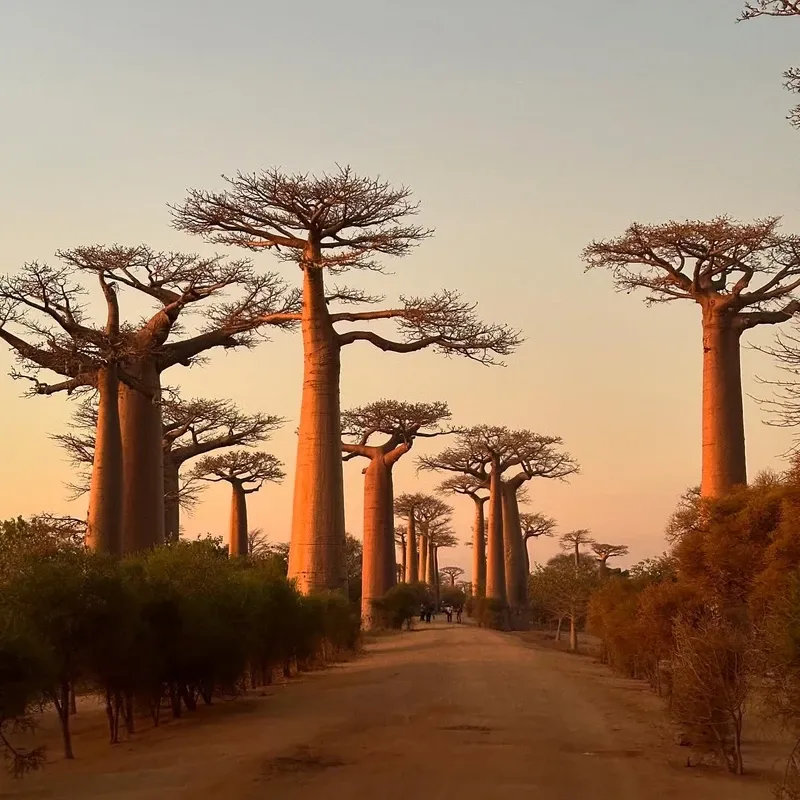
The site sits on a flat coastal plain 20 kilometers northeast of Morondava. Visitors arrive after a 30 to 40-minute drive over deeply rutted terrain. Private taxis from Morondava charge between 50,000 and 100,000 Ariary for a round trip, which typically includes the driver waiting during the golden hour. Budget travelers take a shared taxi-brousse toward Belo-sur-Tsiribihina for 10,000 Ariary, disembark at the Marofototra junction, and cover the remaining six kilometers via tuk-tuk or on foot. The 60 minutes before sunset draw the largest crowds. Tour buses arrive, and the fading light turns the tree trunks a deep orange-red against the flat horizon. Sunrise offers a quieter alternative. Arriving at dawn allows photographers to capture the trees emerging from the morning mist without dodging dozens of other tourists.
Heavy rains from December to March turn the packed dirt and sand into deep mud. Standard vehicles frequently get stuck during these months, and the road can become entirely impassable. Travelers planning a wet-season visit need a 4WD rental, which costs around $6 in fuel and fees for the short 16-kilometer trip from Morondava Airport. The public road remains open 24/7 without an entrance fee, though local villagers collect 2,000 to 5,000 Ariary for parking in the designated dirt lot.
Grandidier's baobabs germinated on the Menabe coastal plain between 800 and 2,800 years ago. They did not grow in isolation. These trees originally stood within a dense tropical forest that blanketed western Madagascar. The thick canopy provided shade for a complex ecosystem of endemic plants and animals, while the baobabs pushed through the upper layers to reach heights of 30 meters.
Human settlement expanded in the region over the centuries. Local populations cleared the surrounding forest using slash-and-burn agriculture, a practice known locally as tavy, to create space for rice paddies and sugarcane fields. The baobabs survived this aggressive clearing process. Their massive trunks, capable of storing up to 120,000 liters of water, made them highly resistant to the agricultural fires. The dense tropical forest disappeared completely, leaving only the isolated baobabs standing on the newly flattened, cultivated landscape.
Route Nationale 8 eventually formalized as a dirt track connecting the coastal city of Morondava to the inland town of Belo-sur-Tsiribihina. The road passed directly through this remaining cluster of giants. Traffic increased as the route became a primary artery for local trade and transport. By the late 20th century, the site gained international recognition, drawing thousands of tourists to the 260-meter stretch of road. Increased foot traffic compacted the soil, while vehicle emissions and physical contact threatened the shallow root systems and bark of the ancient trees.
The Ministry of Environment, Ecology, and Forests recognized the immediate threat to the remaining trees and granted the area temporary reserve status in July 2007. Conservation groups pushed for stronger measures to prevent further degradation of the soil and to stop tourists from carving initials into the bark. The Malagasy government upgraded the site to a full Natural Monument in 2015. This marked Madagascar's first official protection of a specific natural landmark rather than a broad national park. Local authorities now enforce strict rules against climbing the trees, carving the bark, or littering in the surrounding brush.
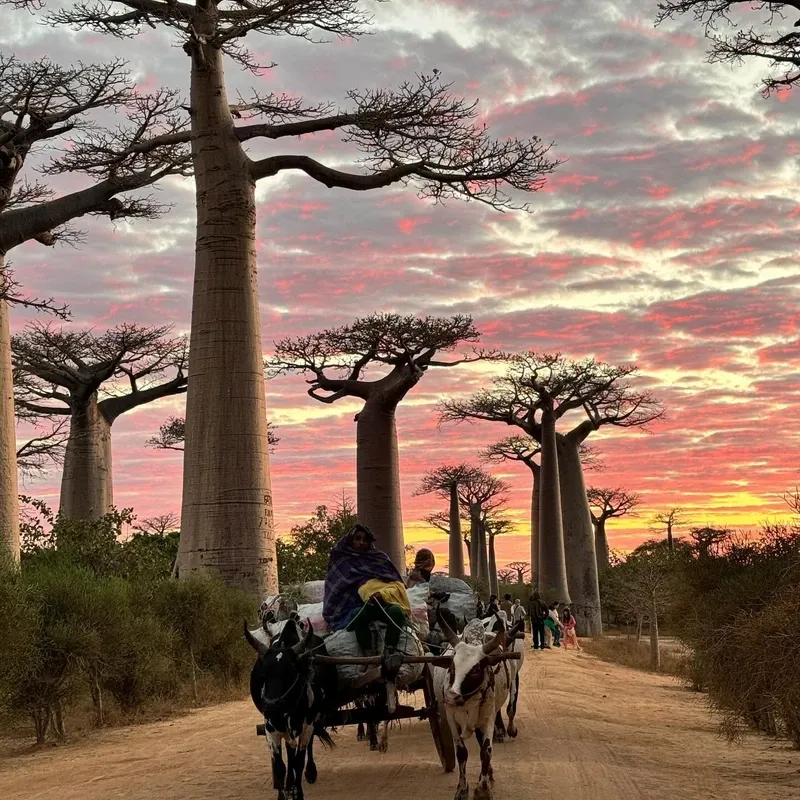
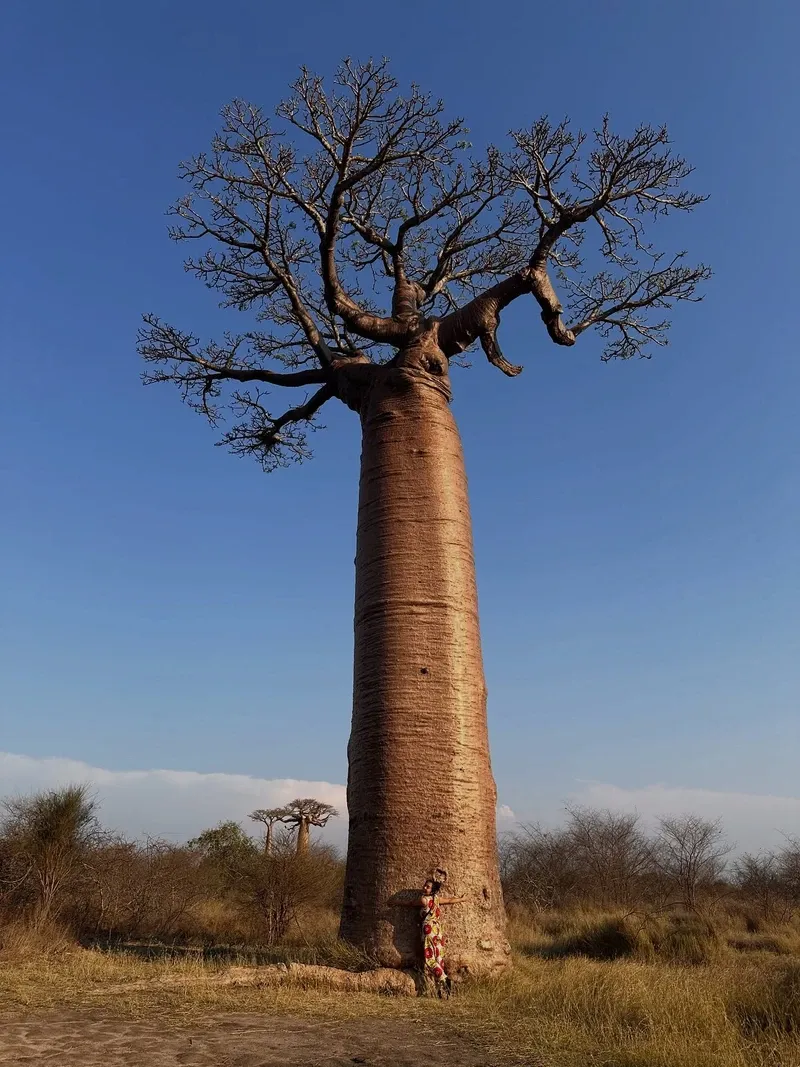
Adansonia grandidieri is the largest of Madagascar's six endemic baobab species. The trees along the avenue reach a maximum height of 30 meters, roughly equivalent to a 10-story building. Their cylindrical trunks grow up to 11 meters in diameter, requiring a circumference of nearly 50 meters at the base. The bark is smooth and grayish-brown, lacking the deep fissures found on typical forest trees. This smooth exterior reflects sunlight, helping the tree regulate its internal temperature during the brutal dry season.
The internal structure of the trunk functions as a massive biological water tower. Spongy wood fibers expand to absorb up to 120,000 liters of water during the rainy season. This adaptation allows the trees to survive the severe eight-month dry season that scorches the Menabe region. The sheer volume of stored water makes the trunks highly fire-resistant, explaining their survival during historical slash-and-burn land clearing. The wood itself is fibrous and wet, making it useless for timber or building materials, which further protected the trees from logging.
Branches only emerge at the very top of the trunk, spreading out horizontally to form a flat, crown-like canopy. Leaves appear only during the wet season from December to March. For the remaining eight months of the year, the bare branches resemble a massive root system reaching into the sky. The trees produce large, white flowers that open exclusively at night, emitting a sour scent to attract nocturnal pollinators like fruit bats and lemurs. The terrain beneath the trees consists of packed red dirt and loose sand. This surface challenges manual wheelchairs, requiring power chairs or all-terrain tires for navigation. The viewing area remains completely flat across the entire 260-meter stretch, requiring minimal physical exertion for elderly visitors or young children. No formal ramps, paved paths, or accessible restrooms exist on-site.
The Malagasy people call the Grandidier's baobab "Renala," which translates directly to Mother of the Forest. These trees hold deep spiritual importance for the communities living in the Menabe region. Locals consider specific, exceptionally large baobabs along the avenue to be sacred entities that house ancestral spirits. Villagers routinely visit the "Sacred Baobab," a prominent tree located just off the main cluster, to leave offerings at its base. Visitors will often see small bottles of rum, coins, or bowls of honey placed between the roots in exchange for blessings, fertility, or protection from illness.
Legends surrounding the trees' unique shape permeate local folklore. One widespread Malagasy myth claims the gods grew angry with the baobab's pride regarding its massive size and beauty. As punishment, the gods ripped the tree from the ground and shoved it back into the earth upside down, leaving its tangled roots exposed to the sky. Another variation suggests the tree kept walking around the earth, so the creator planted it upside down to keep it in one place.
Seven kilometers from the main avenue stand the Baobab Amoureux, two separate Adansonia za trees naturally twisted together. Local tradition states these intertwined trunks represent a young man and woman from rival villages. Their families forbade them to marry, so the couple asked the creator to let them live together as trees. The creator granted the wish, twisting their forms together for eternity. Local artisans carve wooden replicas of these intertwined trees, selling them along the avenue at prices significantly lower than in the capital. Visitors observing any rituals near these sites must ask permission before photographing local people.
Nocturnal lemurs and fruit bats pollinate the baobab flowers, which open exclusively at night.
A single Grandidier's baobab can store up to 120,000 liters of water in its spongy trunk.
The massive water content inside the trunk allows the trees to survive intense brush fires.
The remote location and lack of light pollution make the avenue a prime spot for photographing the Milky Way.
Baobabs do not produce standard annual tree rings, requiring radiocarbon dating to determine their age.
The nearby Baobab Amoureux features two trees twisted together, representing eternal lovers from a local legend.
The avenue became Madagascar's first Natural Monument in 2015, a distinct category from its national parks.
Entry to the public road is free. Local villagers collect a parking fee of 2,000 to 5,000 Ariary for vehicles stopping at the site.
The avenue sits 20 kilometers northeast of Morondava. The drive takes 30 to 40 minutes over a bumpy, unpaved dirt road.
The 60 minutes before sunset provide the best lighting, turning the trunks orange-red. Sunrise offers similar lighting with morning mist and far fewer crowds.
The dirt road turns into deep mud from December to March. You will need a 4WD vehicle, and heavy rains can make the route completely impassable.
The avenue lacks formal public restrooms. A small visitor kiosk nearby occasionally offers basic facilities, but travelers should plan accordingly before leaving Morondava.
Radiocarbon dating estimates the Grandidier's baobabs along the avenue are between 800 and 2,800 years old.
Driving during the day is safe, but travelers should avoid the road between Morondava and the avenue after dark. Armed cattle bandits, known locally as dahalo, operate in the broader region at night.
Lemurs rarely appear at the avenue due to the lack of forest canopy. Visitors looking for lemurs and the apex predator Fossa should drive two hours north to the Kirindy Forest Reserve.
Most visitors spend two to four hours at the site. This includes the drive from Morondava, walking the 260-meter stretch, and waiting for the sunset.
Wear sturdy walking shoes to navigate the uneven dirt and sand. Temperatures frequently exceed 32°C (90°F), so bring sun protection and insect repellent for the mosquitoes that emerge at dusk.
Browse verified tours with free cancellation and instant confirmation.
Find Tours